
How I Use AI in My Creative Business (And Where I Draw the Line)
Do I use AI in my business? Of course I do. I actually use it a lot.
I’m not interested in being the creative who refuses to touch AI because I’m afraid of what it might mean for my industry. Technology changes. Business changes. The way we work changes. I’d rather understand the tools available to me, figure out where they genuinely make my work better, and leave them alone where they don’t.
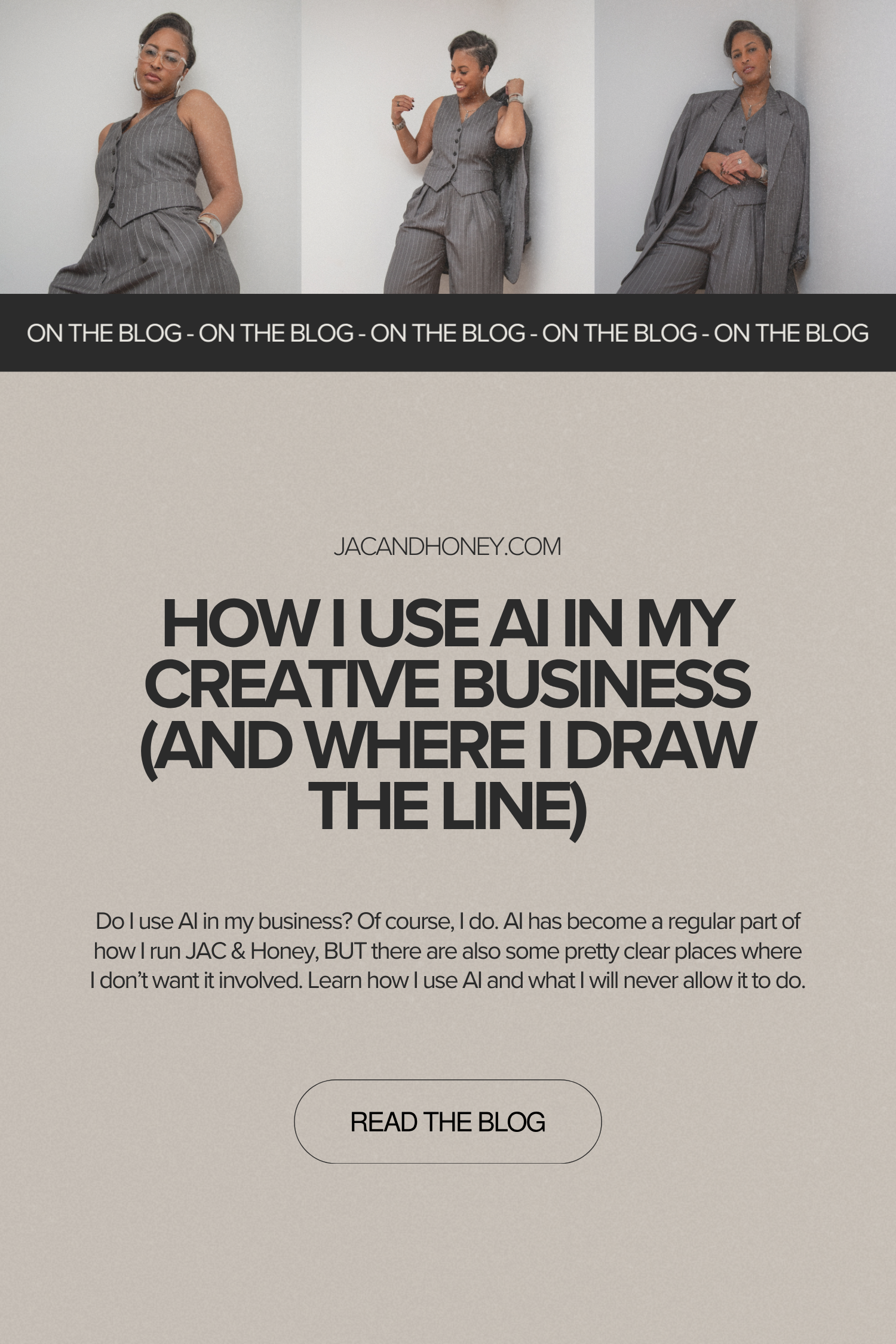
AI has become a regular part of how I run JAC & Honey, BUT there are also some pretty clear places where I don’t want it involved. So, here’s how I use AI in my business—and where I draw the line.
Where AI Has Been Really Good for My Business
I think AI is at its best when it helps me think, organize, analyze or get through work that would otherwise eat up time I could be spending somewhere more valuable.
Basically, I like AI as a thought partner.
1. Client Communication
Sometimes I know exactly what I need to say in an email, but I’m struggling with how to say it. Maybe I need to establish a boundary without sounding cold. Maybe a client asked a complicated question and my first response is three paragraphs longer than it needs to be. Or maybe I just need to make sure what I’m saying is clear.
I’ll give AI the situation, explain what I want the client to understand, tell it how I want the message to feel, and use it to help me refine my response. I’m still deciding what I want to say. I’m just spending less time trying to find the words.
2. Brainstorming
This is probably one of my favorite uses.
I use AI to brainstorm for client work, blog topics, content ideas, offers, names, customer journeys, questions I should be asking and angles I may not have considered.
And I don’t just give it one prompt and take whatever comes back. I talk to it. I give it context. I tell it what I’m thinking. I push back. I tell it when an idea is boring. I ask what I’m missing. Sometimes the first idea leads me to a completely different idea that I never would have gotten to otherwise. That’s where it becomes useful to me.
3. Finding the Themes Hidden in Client Research
This one is GOOD.
When I’m developing a brand, clients give me a lot of information—questionnaires, notes from conversations, ideas they’ve been carrying around in their heads, things they like, things they absolutely do not want. There can be a lot to sift through.
AI can help me organize that information and identify recurring themes. If a client mentions trust five different ways throughout a questionnaire, for example, that matters. If certain words, priorities or feelings keep coming up, I want to notice that. AI helps me see patterns faster. I still determine what those patterns mean for the brand. That part requires strategy, context and knowing the person sitting across from me.
4. Refining Copy
I write first. Then I use AI to help me make it better.
Sometimes that means tightening something that’s too long. Sometimes I want to know where I’ve repeated myself. Sometimes I need a stronger ending. Sometimes I wrote something that makes perfect sense in my head and considerably less sense once it’s on the page. What I don’t want is generic copy that technically sounds good but could belong to anybody.
I’ve spent years developing the voice of JAC & Honey and hours paying attention to the voice of a client. AI can help me refine it, but I’m still the editor.
5. Creating Images for Concepts and Mockups
AI image generation has also become incredibly useful during the concepting stage of my work.
If I’m designing a website and need to show a client what a certain visual direction could look like, I can create imagery that helps bring that idea to life. That doesn’t mean the generated image becomes the final asset. I’m a photographer so I will die on a hill about the image being authentic. But sometimes its job is simply to help us see the vision before we invest the time and money into creating the real thing.
That can make conversations with clients so much easier because we’re no longer trying to describe an idea that only exists in my head.
6. Actually Running My Business
This might be the least glamorous use of AI and one of the most valuable.
I use it to think about JAC & Honey. I’ve used AI to help me plan quarters, evaluate offers, think through pricing, develop workflows, map customer journeys and challenge business decisions. Sometimes I’ll give it everything happening in my business and essentially say, Okay, put your business strategist hat on. What are you seeing that I’m not? I don’t blindly follow the answer. But having something challenge my thinking, ask another question or organize all the pieces in front of me can be incredibly helpful—especially as a business owner who doesn’t have a giant executive team sitting down the hall.
So What Don’t I Use AI For?
Design
Yes, I know AI can design. It can analyze thousands of websites. It can understand common layouts. It can apply design principles. It can recognize trends and gather information about what tends to perform well.
But that’s not really the point to me.
When I sit down to design something, I don’t want to start by asking AI what it thinks it should look like. I prefer to look at the world. I gather inspiration from websites I love, editorial design, TV show intros, coffee-table books, packaging I notice while walking through a store, typography, interiors, fashion, photography and random things I see out in the wild.
Some of those references may have absolutely nothing to do with my client’s industry. And I actually prefer it that way.
AI Doesn’t Have Taste
AI can know design principles. But knowing the rules isn’t the same thing as having taste.
Taste is knowing when something is technically correct and still doesn’t feel right. It’s knowing when to leave more white space, when the obvious font choice is exactly the font you shouldn’t use, or when a tiny detail is throwing off the entire composition.
Taste comes from exposure—from years of looking, making, studying, experimenting and getting things wrong. And that instinct is different from designer to designer, which is why you can give ten talented designers the same brief and get ten different answers.
Could I use AI to design? Absolutely. And my result would probably look different from someone who isn’t a designer because I’m still bringing my experience with typography, hierarchy, color, composition and strategy to the tool. AI doesn’t erase the experience of the person using it.
AI Also Doesn’t Know My Client the Way I Do
AI wasn’t sitting across from my client during our creative call. It didn’t see her face change when she started talking about the part of her business she’s most excited about. It didn’t hear the hesitation when she described something she thought she wanted. It doesn’t know that she keeps saying she wants her brand to feel luxurious, but everything she’s actually drawn to is warm, approachable and understated.
Those little things matter.
Sometimes the most important information I gather from a client isn’t written in the questionnaire at all. It’s something I pick up by being a person talking to another person. And I bring all of that with me when I design.
If You Want to Look Different, Someone Has to Make Different Decisions
This is probably my biggest issue with relying entirely on AI for creative direction.
AI is incredibly good at recognizing what already exists. But if you’re trying to build a brand that doesn’t look like everyone else in your industry, the average of what’s already out there isn’t necessarily where you want to begin.
Differentiation lives in the decisions—the unusual reference, the unexpected layout, the detail somebody else might have removed, the instinct to go left when everybody in your industry keeps going right. Those small decisions are often what make a brand memorable.
And Here’s Where I Come In
When I’m designing a brand or website, I’m not just making something that looks good. I’m paying attention to you—what you say, what you don’t say, what you’re drawn to, where you want your business to go and what will make your brand feel distinctly yours.
AI is absolutely part of my business, and I don’t see that changing. But when you hire me to design your brand, you’re hiring me for the part AI can’t replicate: my taste, my instincts, my experience and my ability to turn everything I’ve learned about you into something that doesn’t look like it could belong to anybody else.
And if that’s what you’re looking for, I’m your girl.
